Energy Security
Recent conflicts in the Middle East and the threat of disruptions to energy flows through the Strait of Hormuz have once again underscored the strategic importance of energy security, reinforcing the lesson already highlighted by Russia’s invasion of Ukraine. It is now clear that a regional crisis can trigger global energy and economic disruption, while Europe’s dependence on imported fossil fuels makes it particularly vulnerable to geopolitical tensions and sharp fluctuations in international energy prices.
Although Greece may have limited ability to directly influence international developments, it can strengthen its energy resilience and mitigate their impact on the economy and society. These impacts are reflected in the increased burden on households and businesses, as well as in the need to allocate significant public resources to contain energy costs.

Domestic Energy Resources and Storage as Pillars of National Resilience
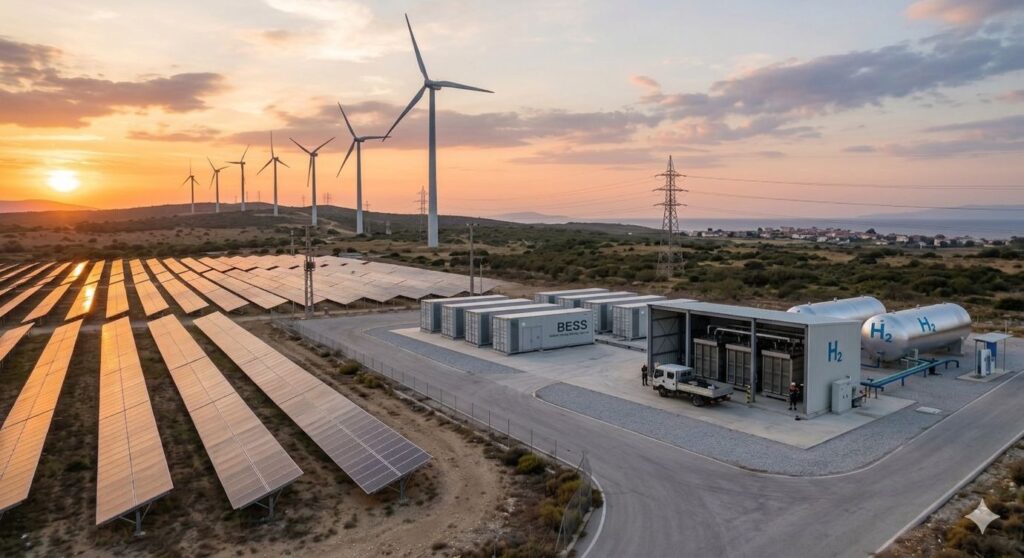
By contrast, Greece has a rich and diversified renewable energy potential, alongside significant opportunities for the development of energy storage systems. Harnessing these resources is not merely an environmental choice, but a strategic policy for energy autonomy, economic protection and national resilience, as renewable energy sources have virtually no fuel costs and are not dependent on international maritime routes, pipelines or geopolitical instability.
It is widely recognised that expanding domestic energy generation can reduce the country’s exposure to international price fluctuations and provide greater stability and predictability in electricity costs. The importance of renewable energy is also reflected in the Levelized Cost of Energy (LCOE). According to Lazard’s 2025 international analysis, onshore wind and utility-scale solar PV remain among the most cost-competitive power generation technologies. Indicatively, the LCOE for onshore wind is estimated at USD 37–86 per MWh, while utility-scale solar PV ranges from USD 38–78 per MWh, compared with USD 149–251 per MWh for gas peaking plants.
Greater penetration of renewable energy therefore places downward pressure on wholesale electricity prices, as these technologies reduce the number of hours during which more expensive fossil-fuel generation units set the market price. This effect is not always automatically or fully reflected in retail electricity bills, which also incorporate network costs, taxes, regulated charges and other components. Nevertheless, an energy mix with a greater share of economically competitive domestic renewable generation and lower exposure to international natural gas prices creates the conditions for lower and more stable electricity prices for consumers.
However, given the intermittent nature of renewable energy, the role of energy storage must also be placed at the centre of the discussion. Combining renewable generation with energy storage will enable domestic renewable resources to be utilised across a broader range of hours throughout the day, further reducing the need to dispatch more expensive generation units relying on imported fuels. This combination can transform Greece’s domestic renewable potential into tangible energy security and measurable economic benefits for citizens and the national economy.
Electrification
The limitations and challenges associated with Europe’s reliance on expensive imported fossil resources are now also reflected in European energy planning, which is clearly moving towards greater electrification. Electric mobility, heat pumps, industrial electrification and the growing electricity requirements of digital infrastructure, including data centres, are expected to significantly increase electricity demand in the coming years. Unless Greece secures the necessary renewable energy, storage and grid infrastructure in a timely manner, it risks facing rising demand without a corresponding supply of affordable domestic generation.
The infrastructure required over the next decade cannot begin to be planned once additional demand has already materialised. Projects require years of development, studies, permitting, grid capacity, financing and construction. The decisions being made today at the institutional and regulatory level will determine whether Greece is prepared to successfully address the energy challenges of tomorrow.
The New Special Spatial Planning Framework for Renewable Energy Sources
The revision of the Special Spatial Planning Framework for Renewable Energy Sources represents one of the most significant institutional interventions for the country’s energy future, particularly given that the existing framework has been in force since 2008. The new framework will not simply determine where renewable energy projects may be developed. It will shape, for many years to come, Greece’s ability to make optimal use of its domestic renewable resources, reduce its dependence on imported fuels and respond to continuously growing electricity demand.
In all cases, the development of renewable energy must be accompanied by rigorous environmental assessment and effective protection of the natural and cultural environment, biodiversity and landscape. However, the principle of rational spatial planning should under no circumstances be confused with the shrinking of available space through blanket prohibitions and horizontal exclusions. A modern spatial planning framework should direct projects towards the most suitable areas based on up-to-date technical, environmental, energy and socioeconomic data.
Onshore wind energy, in particular, should be assessed on the basis of its actual contribution to the energy system. It represents a domestic renewable resource with high energy productivity and competitive costs, capable of generating electricity during periods when solar PV output is limited or zero. Furthermore, the permanent land footprint of a wind project represents only a small proportion of its overall area, as surrounding land can continue to support forestry, livestock farming and other compatible activities.
The Risk of a Framework That Could Have the Opposite Effect
The purpose of Special Spatial Planning Frameworks is to provide clear guidance to stakeholders and permitting authorities, ensure legal certainty, establish a clear hierarchy between planning frameworks, and define consistent and predictable rules based on scientific methodologies and tools that have already been applied through the many years of renewable energy development in Greece and internationally.
Conversely, the introduction of ambiguous concepts, overlapping responsibilities and restrictions without adequate scientific justification could produce an outcome contrary to the one intended. Rather than simplifying procedures and reducing conflicts, such provisions could create significant obstacles by leading to divergent interpretations among public authorities.
A framework lacking sufficient supporting evidence could also make administrative decisions concerning projects necessary to achieve national energy targets more vulnerable to legal challenges. The result could be delays to mature investments through prolonged litigation, the loss of productive areas with significant renewable energy potential, and increased uncertainty for businesses, public authorities and local communities.
To avoid such an institutional “backfire”, substantive and targeted changes are required before the framework is finalised. Restrictions should be proportionate, scientifically justified and linked to the actual characteristics of each area, drawing on the sector’s extensive experience in renewable energy development. At the same time, the legitimate expectations of project developers who have already proceeded with permitting processes in accordance with legal requirements must be protected, while a clear and workable transitional framework should be established.
The Public Interest
The critical question, however, is arguably not whether further development of renewable energy should be pursued instead of conventional fossil fuels. This represents an artificial and ultimately counterproductive dichotomy, as each resource plays a role in ensuring the reliable operation of the electricity system. The real challenge is how to develop the energy infrastructure required while minimising environmental and social impacts and maximising the benefits for the country.
Greece has an opportunity to build a more autonomous and resilient energy system based on the right combination of renewable energy, energy storage and modern grid infrastructure. To achieve this, it needs rules that are stringent where necessary, while also being clear, evidence-based and enforceable. The new Special Spatial Planning Framework should therefore serve as a tool for rational development rather than a mechanism for blanket restrictions. Particular attention should also be given to the role that institutional intervention could play in strengthening the broader social acceptance of renewable energy projects through a meaningful increase in compensatory benefits for local authorities and communities.
One practical and substantive intervention could be to establish a mechanism enabling Local Government Authorities (OTAs) to procure electricity directly from renewable energy facilities located within their respective jurisdictions, at a cost representing a fraction of the current expenditure that places a significant burden on their budgets.
Conclusion
Ultimately, the discussion is not solely about the renewable energy sector or the allocation of land uses. It directly concerns the public interest, energy security, the cost of electricity, the competitiveness of the economy and the country’s resilience in the face of international crises beyond its control.